Showing posts with label process control. Show all posts

Saturday, October 20, 2012

Feedback Control Closed-Loop Transfer Function


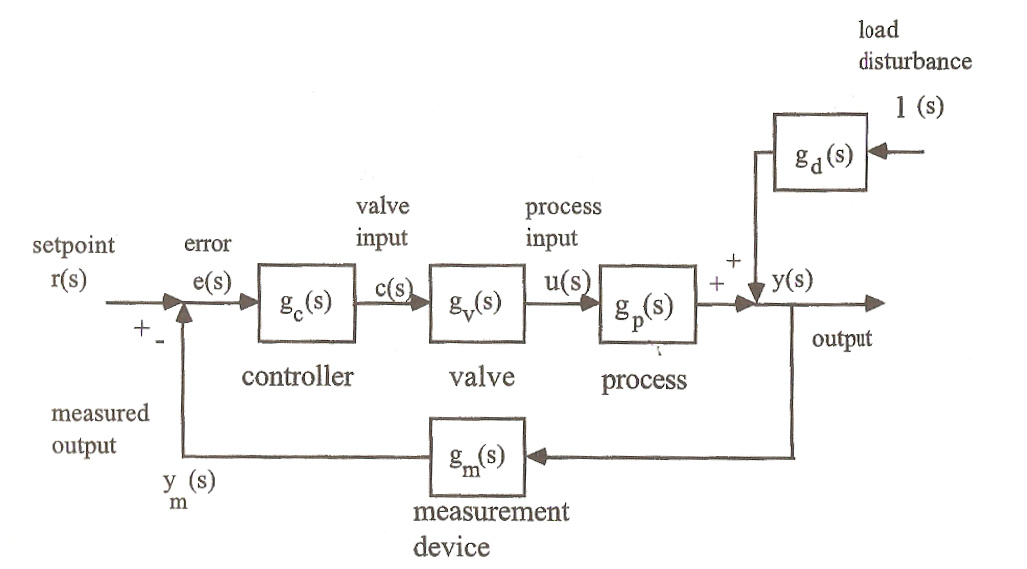
Figure source:

B. Bequette, Process control: modeling, design. and simulation, Prentice Hall Press, Upper Saddle River, NJ 2002

Block diagram (Laplace domain) variables:
c(s) = controller output
e(s) = error
r(s) = setpoint (reference signal)
u(s) = manipulated variable
l(s) = load disturbance
y(s) = process output
ym(s) = measured output

Transfer functions:
gc(s) = controller
gv(s) = valve
gp(s) = process
gm(s) = measurement
gCL(s) = closed-loop
gd(s) = disturbance

Calculations:

y(s) = l(s)gd(s) + u(s)gp(s)
u(s) = c(s)gv(s)
c(s) = e(s)gc(s)
e(s) = r(s) – ym(s)
ym(s) = y(s)gm(s)

Lump all expressions together, we can get the following:

y(s) = l(s)gd(s) + c(s)gv(s)gp(s)
y(s) = l(s)gd(s) + e(s)gc(s)gv(s)gp(s)
y(s) = l(s)gd(s) + (r(s) – ym(s))gc(s)gv(s)gp(s)
y(s) = l(s)gd(s) + (r(s) – y(s)gm(s))gc(s)gv(s)gp(s)

then:
Equation (1)

If there is no disturbance:

Equation (2)


Equation (3)

Sunday, September 23, 2012

L'Hospital's Rule

I found the L'Hospital's rule extremely useful when I was doing process control homework tonight. So if you are not familiar with it, or can't recall it clearly, here it is.


In words, if taking limit directly doesn't work out, one thing you can do is to take derivative of the numerator and the denominator at the same time. Then take limit. Remember, after this step, if the limit still doesn't work, you can apply the L'Hospital's rule again and again until you find a way that the limit can be taken.

This can be simply applied to the initial value theorem and final value theorem in process control.

                    Initial Value Theorem
                    Final Value Theorem
                                                   
                    where F(s) is the Laplace transformation of f(t).

Hope this will help someone who are looking for a way to solve the limit problems.