Showing posts with label Chme. Show all posts

Saturday, October 20, 2012

Feedback Control Closed-Loop Transfer Function


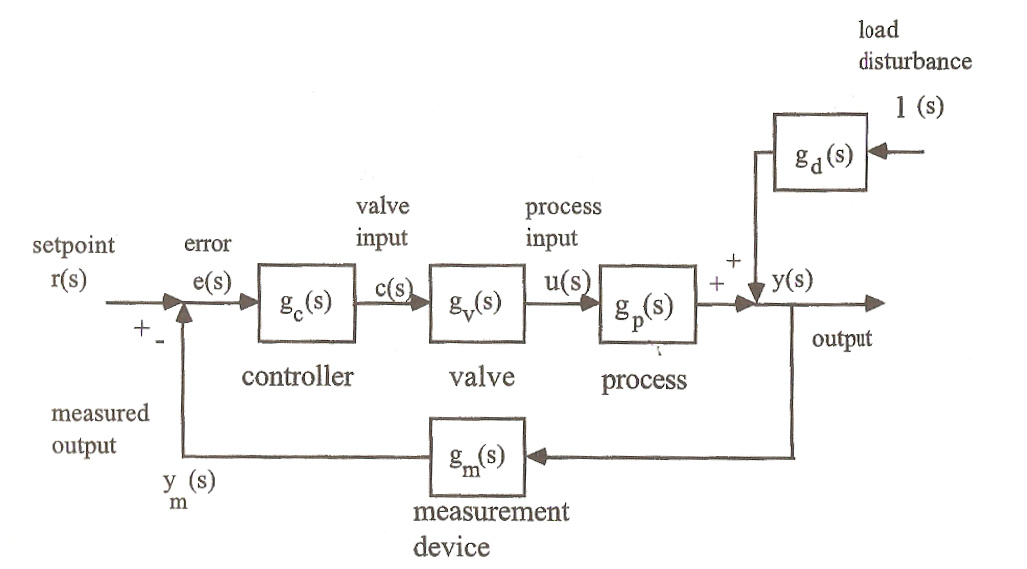
Figure source:

B. Bequette, Process control: modeling, design. and simulation, Prentice Hall Press, Upper Saddle River, NJ 2002

Block diagram (Laplace domain) variables:
c(s) = controller output
e(s) = error
r(s) = setpoint (reference signal)
u(s) = manipulated variable
l(s) = load disturbance
y(s) = process output
ym(s) = measured output

Transfer functions:
gc(s) = controller
gv(s) = valve
gp(s) = process
gm(s) = measurement
gCL(s) = closed-loop
gd(s) = disturbance

Calculations:

y(s) = l(s)gd(s) + u(s)gp(s)
u(s) = c(s)gv(s)
c(s) = e(s)gc(s)
e(s) = r(s) – ym(s)
ym(s) = y(s)gm(s)

Lump all expressions together, we can get the following:

y(s) = l(s)gd(s) + c(s)gv(s)gp(s)
y(s) = l(s)gd(s) + e(s)gc(s)gv(s)gp(s)
y(s) = l(s)gd(s) + (r(s) – ym(s))gc(s)gv(s)gp(s)
y(s) = l(s)gd(s) + (r(s) – y(s)gm(s))gc(s)gv(s)gp(s)

then:
Equation (1)

If there is no disturbance:

Equation (2)


Equation (3)

Thursday, September 6, 2012

First Post

This is my first post in the blog. After doing all 4000 level chemical engineering homework together with Ken, Chris and Hisham, I think this blog will be interesting for people to share their chemical engineering experiences.

As usual, we were doing ChmE homework again in library. After spending almost 4 hours trying to solve one single problem, we found that the problem statement could be wrong. More ironically, when we did the same question yesterday, we found that the question was different in 2nd edition and 3rd edition textbook. With common sense, we followed the newer version. But, today we found that the 2nd edition was correct?

First lesson: 

Get the "real" book or you will regret.

Question:


Are the molecular sieves used in pressure-swing adsorption?


Since this is the first post of the blog, I do not want to make it so intense.